
Four flats were approved at The Lodge on the Common on 21 August, by a route that could not weigh the objections from the Forum and the Commons Conservators.
Tunbridge Wells Borough Council has approved the conversion of The Lodge on the Common into four flats. The decision notice was issued on Friday 21 August.
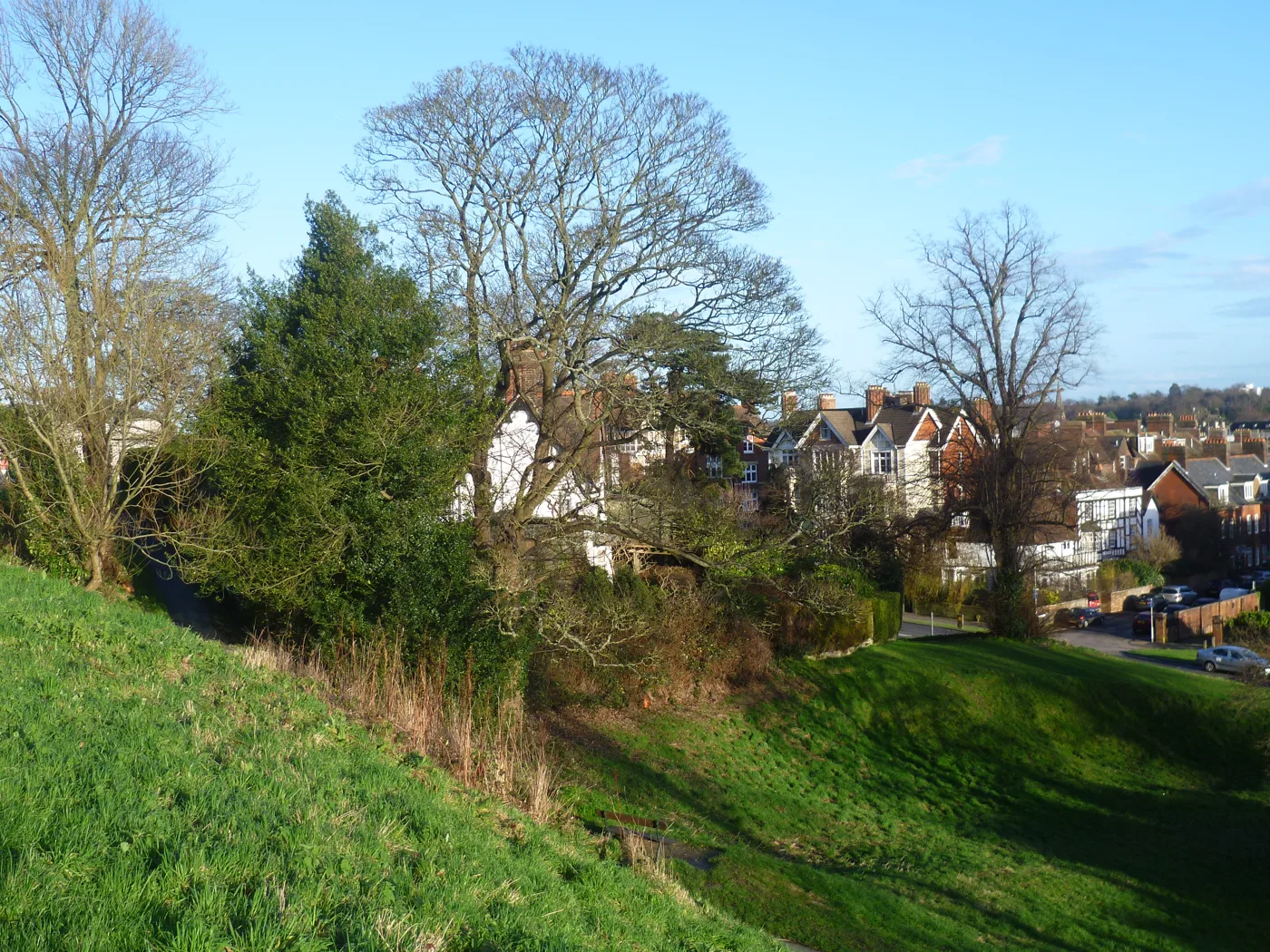
The building sits at the junction of London Road and Major York’s Road, at the southern tip of Tunbridge Wells Common, a few minutes’ walk from the Pantiles. It is two storeys, white rendered, with a slate pitched roof and a parking area in front. The Common wraps around two sides of it.
Nobody objected to the application that was approved. The council’s report records no comments in support and none in objection. (Delegated report, 26/01507/PNEC)
That is not the whole picture. A second, near-identical application for the same building is still sitting undecided at the Town Hall, and two organisations have objected to it in detail: the body that manages the Common, and the music venue 104 metres up the road.
What was approved
The approved application was a prior notification under Class MA of the permitted development rules, which lets a commercial building in Class E become homes without a full planning application.
- Four dwellings, across both floors
- No changes at all to the outside of the building
- One condition: a noise scheme meeting BS 8233:2014 must be approved before work starts, and carried out before anyone moves in
- The work must be completed within three years of the approval date, so by 21 August 2029
(Decision notice, 26/01507/PNEC)
This is the site’s third permission for the same idea. Prior approval was granted in December 2019, and full planning permission for a conversion into four flats followed in December 2022. That permission was never implemented and has expired.
Why the objections could not count
Under Class MA the council is not deciding whether flats here are a good idea. It may only consider a fixed list of matters, and it has to grant approval if those are satisfied.
Noise is on the list, but only in one direction: the effect of commercial noise on the people moving in, not the effect of the new residents on the businesses already there. The council’s report deals with it in a sentence, recording that no commercial properties are adjacent to the development or in the same building.
Southern Water asked for details of surface water drainage. The report notes the request and records that it “falls outside the scope of this prior notification”.
The application that is still open
Running alongside the prior notification is a full planning application, 26/01264/FULL, for the same conversion with minor external alterations. The applicant’s own statement says it is identical to the permission that lapsed in 2022.
It was validated on 5 June, its consultation closed on 26 June, and its determination deadline of 31 July has passed. It was still marked “Awaiting decision” on 25 August. That is the application carrying the objections.
The Forum: “wrong by two hours, on the busiest nights”
The Tunbridge Wells Forum, the grassroots music venue at Fonthill on the Common, has objected. The venue is run by Forum Music & Arts CIC and sits about 104 metres from the site.
Its objection does not oppose housing. It says the noise evidence behind the application does not stand up, and that the cost of getting it wrong will land on the venue rather than the developer. Its main points:
- The report is out of date. The acoustic assessment was written on 1 November 2022 for the superseded application, and rests on a single survey weekend now more than three years old.
- It surveyed the venue at its quietest. The nights measured drew fewer than 50 and fewer than 150 people. The venue’s regular full-capacity events run to around 250, sometimes in bass-heavy genres.
- One surveyed night was not even at the Forum. The report’s own appendix names “The Forum Basement”, which is a separate venue in the basement of the Sussex Arms on the other side of the Pantiles. The Forum’s own website confirms the two addresses. (Tunbridge Wells Forum, Get Here)
- A load-bearing fact is wrong. The report concludes that commercial premises “all have a 23:00 hour cut off”. The Forum’s premises licence allows live and recorded music until 01:00 on Fridays and Saturdays, with opening to 01:30. The objection calls that “wrong by two hours, on the busiest nights, in the direction that matters most”.
- Dispersal is not assessed at all. Up to 250 people leaving at 01:00 to 01:30, alongside customers from the Pantiles’ other licensed venues, many of them walking across the Common and along the A26 past the site.
- The masking argument answers the wrong question. Traffic on the A26 dominates the measured average, but the objection argues that steady traffic noise is habituated to while rhythmic bass is not.
The venue asks the council either to require an updated assessment covering the real licensed hours, a representative busy night and late-night dispersal, or, if it grants permission, to impose conditions protecting the venue’s existing operation, including its annual Unfest. (Objection, 26/01264/FULL)
This is the agent of change principle, set out at paragraph 187 of the National Planning Policy Framework: the responsibility for managing the effects of an existing noise source falls on the new development, not on the business that was there first.
The Commons Conservators: the car park is a registered encroachment
The Commons Conservators, who manage Tunbridge Wells and Rusthall Commons under the County of Kent Act 1981, have also objected.
Their case rests on the land around the building rather than the building itself:
- The Commons are a Local Wildlife Site (TW24) and the majority of the 256 acres is registered as a village green (VG22).
- The Lodge itself is left out of that registration, but all the surrounding land is registered.
- The tarmac parking area in front is a registered encroachment, first reported by the Conservators’ surveyor in December 1972. The Conservators have not tried to reclaim it, but say any development changing that area would need their permission, and that any further encroachment would be prevented.
Their practical worry is what four households do with a forecourt on a village green: bins, washing lines, bicycle storage and children’s toys, which they say would disturb and interfere with the green. They ask whether a planning condition or a restrictive covenant could deal with it, and ask the council to reconsider visual impact.
They also ask for an informative to be added, warning the applicant that separate consent may be needed under the County of Kent Act 1981 and the Commons Act 2006, and reminding them that no building materials, tools or equipment may be placed on the Common and no construction or delivery vehicle may park on it or overrun the grass. (Commons Conservators objection, 26/01264/FULL)
The Conservators’ role is under a fresh spotlight this summer, because the Commons themselves are part of the Pantiles estate that went on the market on 6 August.
The office that is leaving
The building is owned and occupied by Law 365, a solicitors’ firm. The applicant’s statement says the firm employs 27 full-time staff and that the building is no longer big enough to hold them all at once, so it is moving to a larger office.
Law 365’s own website now gives its Royal Tunbridge Wells office as Room 18, Pantiles Chambers, 85 High Street, checked on 25 August. (Law 365, contact)
The building was not always offices. The heritage statement submitted with the application says it was converted from a former garage that had historic ties to the buildings across the road.
What it means for you
- The four flats are now lawful, whatever happens next. The prior approval stands on its own and runs to 21 August 2029.
- If you want a say, it has to be on 26/01264/FULL, the full application for the external alterations, which is still undecided. Comments go to Tunbridge Wells Borough Council quoting that reference.
- If you live near a music venue, this is the case to watch. Whether the council treats the Forum’s evidence as a reason to strengthen conditions will set the tone for the next conversion near the Pantiles.
- The forecourt is not ordinary private land. Anyone buying one of these flats should know the parking area is recorded as an encroachment on a registered village green, and that the Conservators say changes to it need their consent.
- Bins are already spelled out. The council’s refuse team has specified communal containers for the building: one 660 litre refuse bin, two 360 litre bins for paper and card, two 240 litre bins for plastic, glass and tins, and a 140 litre food bin with four caddies, all to be bought from the council by the developer before the flats are sold or occupied.
Related: Tunbridge Wells planning news, The Pantiles and the Commons for sale and Tunbridge Wells house prices.
Sources: Tunbridge Wells Borough Council planning register, 26/01507/PNEC delegated report and decision notice, both issued 21 August 2026, and 26/01264/FULL, status checked 25 August 2026; the applicant’s design and access statement and heritage statement, July 2026; consultee and third-party comments on 26/01264/FULL from the Commons Conservators, the Tunbridge Wells Forum and TWBC Client Services; Tunbridge Wells Forum; Law 365.
Have your say