
An Upper Tribunal has upheld a £5.4m corporation tax bill on the Isle of Man company behind Knights Wood, which returned £28.3m of profit from the 550-home estate.
The Isle of Man company behind the Knights Wood estate in Royal Tunbridge Wells has lost its appeal against a £5.4m corporation tax bill. The Upper Tribunal dismissed the appeal on 25 August.
Knights Developments Limited developed and sold the homes at Knights Wood, off Knights Way in the north of the town. It argued that its profits were taxable only in the Isle of Man, where it is resident, and not in the United Kingdom. Two judges disagreed.
The decision, neutral citation [2026] UKUT 00329 (TCC), was given by Mr Justice Nicholas Thompsell and Judge Swami Raghavan after a two-day hearing on 14 and 15 May.
What the estate made
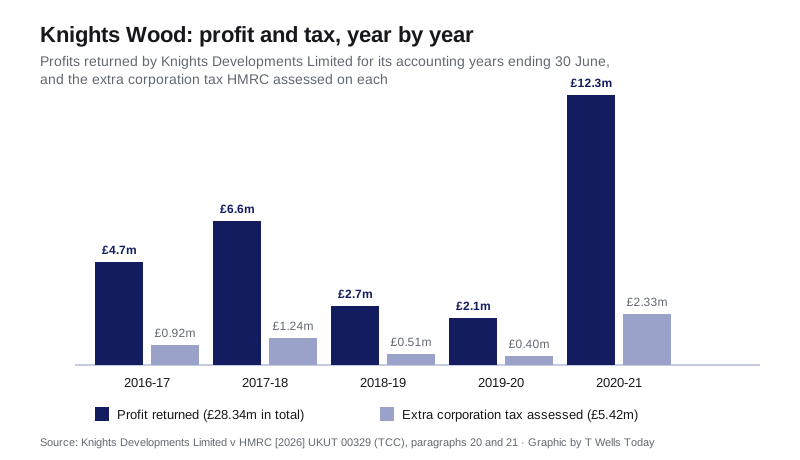
The company’s own returns, set out in the full judgment, record the profits from the site across five accounting years:
- year to 30 June 2017: £4,685,123
- year to 30 June 2018: £6,552,444
- year to 30 June 2019: £2,692,084
- year to 30 June 2020: £2,126,996
- year to 30 June 2021: £12,286,921
That is £28,343,568 over the five years. HMRC issued closure notices on 28 July 2022 for the first four years and on 1 September 2022 for the last, assessing additional corporation tax of £5,420,051 in total.
The land itself cost far less. The judgment records that the company contracted to buy it from Kilmartin Properties (TW) Limited under an agreement dated 12 March 2010, at £9m excluding VAT.
The permission that created the estate
Tunbridge Wells Borough Council’s own planning register records the outline permission, reference 13/02885/OUT. It was received on 4 October 2013 and permitted on 27 January 2014.
The permission covered a primary school, up to 550 homes and up to 700 square metres of non-residential floorspace, along with the access, roads, open space and drainage. Later applications on the register show the estate coming forward in phases, including 119 homes in phase two.
Why the tribunal sided with HMRC
The company had no permanent establishment in the United Kingdom, and HMRC did not argue otherwise. It did not build the houses itself either. For each phase it signed design and build contracts with Dandara Limited, another Isle of Man company in the same group, which did operate here through permanent establishments.
An agency agreement dated 6 May 2014 paid Dandara Limited commission of 1.5% of the sale price of each completed home. Strategic decisions, including whether to accept an offer, were taken in the Isle of Man.
The argument turned on which article of the 2018 double taxation agreement between the UK and the Isle of Man applied. The tribunal held that the profits were “income derived from immovable property” under Article 6, so the UK could tax them. It rejected the company’s case that Article 6 only reaches passive income from using property, and found that Article 13 deals with capital gains rather than trading profits.
The judgment also notes how much rides on it. Knights Developments’ appeal is the lead case for other companies in the same group whose appeals have been stayed. HMRC told the tribunal that similar claims across the wider industry could be worth up to £1bn in historic refunds and up to £230m a year in future revenue.
What it means for you
Nothing changes on the ground at Knights Wood. The homes were built, sold and occupied years ago, and this is a dispute about tax on profits already made.
- The money goes to HMRC, not to Tunbridge Wells Borough Council. What the borough secured from the site was set separately in planning, through the conditions and the section 106 agreement attached to 13/02885/OUT.
- Those obligations are still being adjusted. An application in January 2025, reference 25/00242/MOD106, sought to modify the agreement to change the Blackhurst Lane and Home Farm Lane lighting contributions and add an activity trail. The register shows it as decided.
- The figures are a rare public look at what a large allocation is worth to the company building it. That is worth holding in mind while the borough works through the Local Plan allocations, the largest of which is about 2,450 homes at Paddock Wood and east Capel.
- If you own at Knights Wood, the ruling has no effect on your title or your home’s value. For what homes in the borough are actually selling for, see our house price page.
A further challenge would have to go to the Court of Appeal, and would need permission. We will update this page if one is filed.
Have your say