
Permit parking for 2,884 homes around St John's Road is back before councillors on Monday. Wednesday: the South East Water report and new planning rules.
Two council meetings fall in the week from Monday 12 October. The first asks whether residents around St John’s Road should be surveyed again about permit parking. The second is Full Council, which takes the inquiry into South East Water and new national rules for planning committees.
Both meetings are public and webcast. (Tunbridge Wells Borough Council meetings calendar)
Monday 12 October, 6pm: Joint Transportation Board
The board brings borough and Kent County councillors together on roads and parking. It meets online. (Agenda)
Permit parking around St John’s Road. Some residents at the southern end of St John’s Road want resident permit parking. Officers ask the board whether to run a fresh informal consultation. They make no recommendation either way. (Parking in St Johns Road area report)
The council has asked this question twice before, in 2008 and 2013. Each time, support across about 2,884 homes reached only around 10%, and no zone followed.
The report sets out the case both ways:
- the area, known as Zone J, is still where most permit requests in the town come from
- but there have been only 25 requests in six years, which “would not normally be regarded as substantial interest”
- the few who complain do so “quite forcefully”, the report says
- a new zone would take about 18 months from first work to signs going up
- a zone usually pushes parking into the next streets, and may need extra yellow lines at junctions
The suggested survey area is the same as in 2013. It is bounded by Culverden Park to the west, Southfield Road and Mereworth Road to the north, Queens Road to the east and Upper Grosvenor Road to the south.
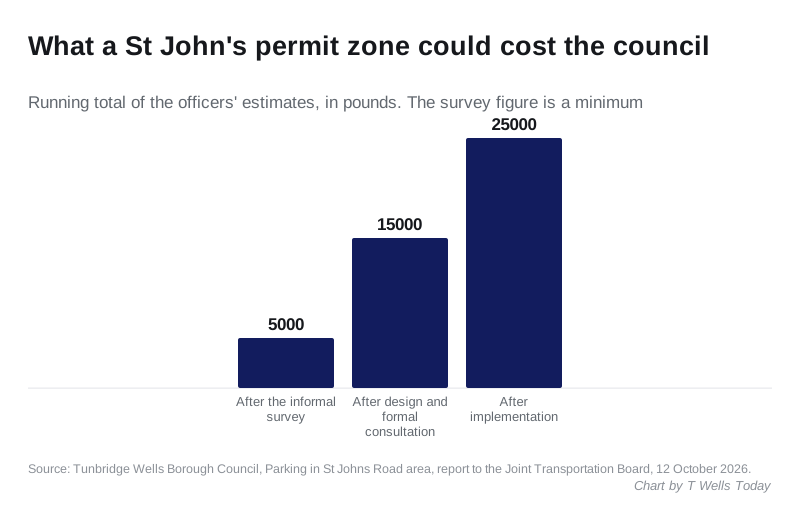
The survey alone would cost at least £5,000. Design work and a formal consultation would take the total to an estimated £15,000. Putting a zone in would add a further £10,000.
Three more car club bays. The council wants three new Co Wheels car club bays in the town:
- Mount Sion, near its junction with the High Street
- Prospect Road, near Princes Street
- St Luke’s Road, near Stephens Road
The consultation drew five responses: four objections and one comment. But an error in the online form failed to capture some respondents’ contact details. The law requires the council to write to objectors, so it must now run the consultation again. The scheme has 10 cars and 560 members in the borough, up 25% in 13 months. (Car Club bays report)
Rusthall High Street cycle route delayed again. Building work on phase 1 of the Langton to Rusthall to the Commons route was due this autumn. It is now expected to start in summer 2027, after delays to the highways contractor’s programme. Two six-bike hangars opened in the town centre in July, on the Pantiles Lower Walk and between Monson Road and Crescent Road car park. (Active Travel update)
The board also notes Kent County Council’s list of planned resurfacing, drainage and footway schemes for 2026/27 and 2027/28. (Highway Works Programme)
Wednesday 14 October, 6.30pm: Full Council
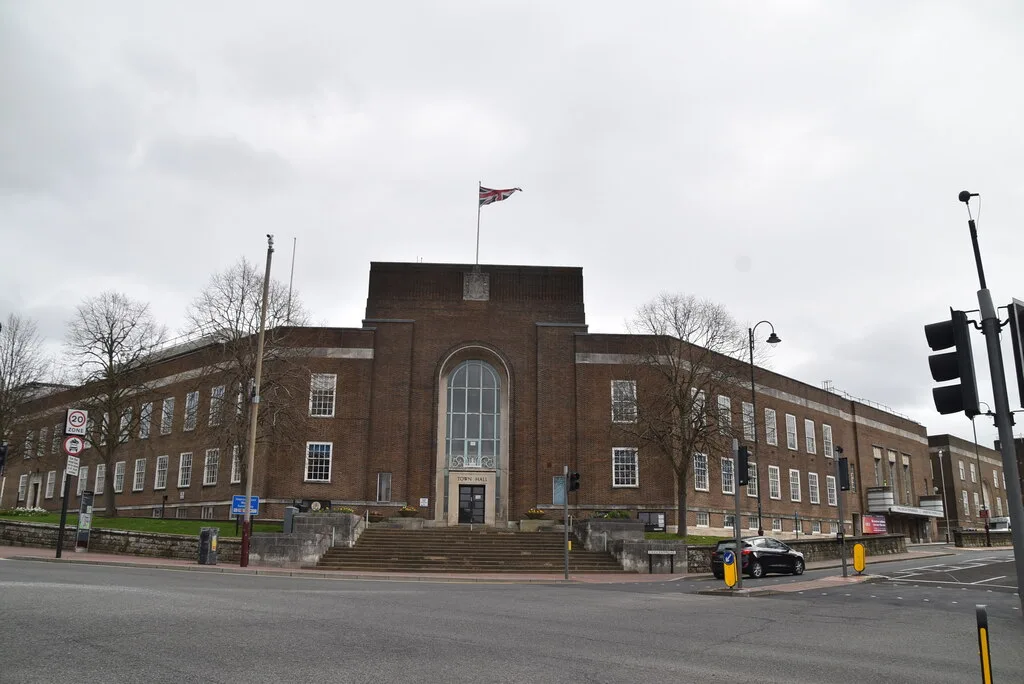
All councillors meet in the Council Chamber at the Town Hall. (Agenda)
South East Water. Councillors take the report of their inquiry into last winter’s outages. It finds “no confidence” that outages will not happen again and makes four recommendations. We have covered it in full: South East Water: council report says outages may recur.
Ward councillors lose the right to call in planning applications. New national rules take effect on 31 October under the Planning and Infrastructure Act 2025. Full Council is asked to rewrite its constitution to match. (Changes to the Planning Committee report)
What changes:
- householder and minor applications must always be decided by officers
- major schemes, of 10 or more homes, go to officers by default
- a major scheme reaches the committee only if a nominated officer and a nominated councillor agree it passes a “referral test”
- ward councillors “will no longer have the ability to ‘call-in’ an application”
- committees are capped at 13 members; Tunbridge Wells has 11, so it stays the same size
Residents’ questions. Members of the public have tabled nine questions. Three challenge the council over Royal Victoria Place. One asks whether the council would hold a borough-wide referendum on the investment. The other six cover energy, climate and the environment. Our report on the £23.5m Palm Court plan explains what goes to the vote on 11 November. (Public questions)
The meeting also takes a political balance report, which was still marked “report to follow” on Sunday, and the Audit and Governance Committee’s annual report.
What it means for you
If you live in the streets between Culverden Park and Queens Road, Monday’s decision could put a permit survey through your door. Whether or not you want permits, that is the moment to answer. Twice before, low support settled it. For parking in the town now, see our parking in Tunbridge Wells page.
From 31 October, if you object to a large application, your ward councillor can no longer force it to committee. Comments on the planning register become the main way to be heard. Our planning news page tracks the big schemes.
To watch either meeting, open its agenda page and follow the webcast link.
Have your say